How to change software providers without losing control
Code, data, access and first checks for a handover that keeps daily operations running.
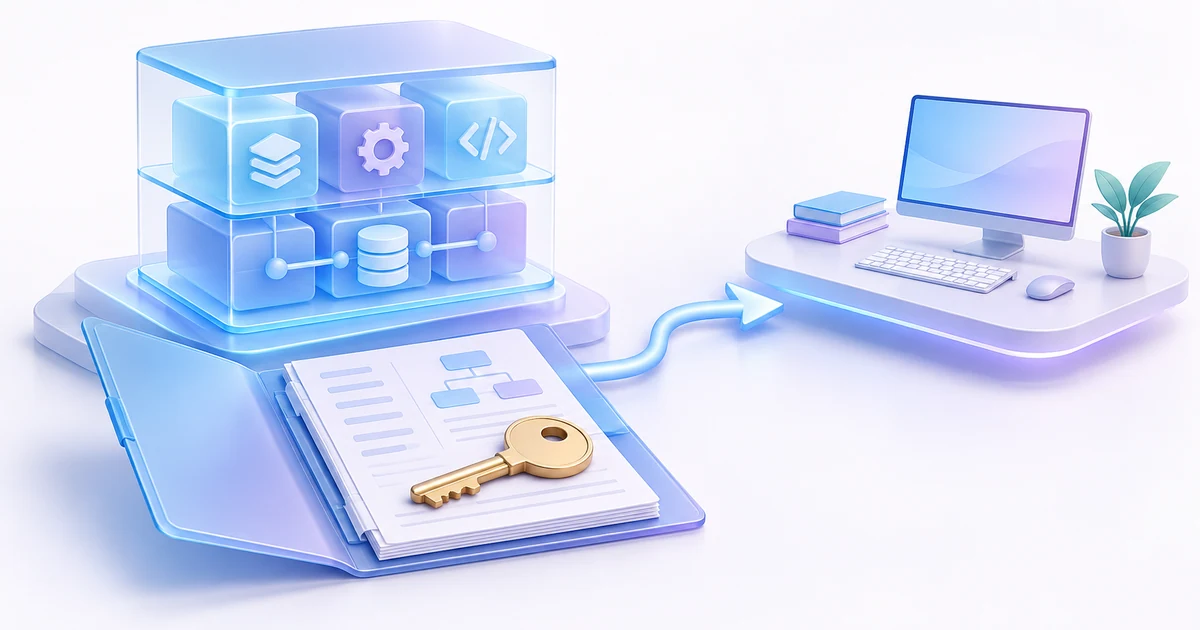
Software built by another provider can keep supporting your business after the original developer is unavailable. If you need to change providers, start by identifying the materials you have, what must keep working and which checks are still missing.
Taking over the application requires authorized access, an identifiable version of the code, the relevant data and someone who understands how it should behave. Before deciding to rebuild, work out what makes the existing application hard to run and which parts no longer meet the team's needs.
Describe what must keep working before you change providers
Start with the reported bugs and describe real workflows too. For example, opening a job, assigning a task, updating a customer or producing a document. Note who performs each one and what outcome they expect.
For each problem, record the starting state, steps, expected result and actual result. Note whether it only occurs with particular data or users. Use examples with no confidential information in the initial assessment, and agree technical access as part of the assignment.
What to collect for the software handover
List what the company controls, what it can obtain and what is missing. For access, record the service, its owner and the authorized way to grant access. Keep passwords out of the inventory.
| Area | What to collect | How to verify the handover |
|---|---|---|
| Code | Repository, history and the live version | The new owner identifies the version and starts the app in a test environment. |
| Data and files | Database, attachments, exports and backup method | Test a restore or import in a separate environment. |
| Hosting and domain | Accounts, DNS settings and renewals | The authorized contact can see and manage the relevant services. |
| External services | Email, payments, APIs, webhooks and active subscriptions | Identify how each integration works and who owns it. |
| Release process | Instructions, required configuration and dependencies | Prepare a test release and a rollback plan. |
| Open work | Issues, decisions and incomplete features | People who use the system recognize the priorities. |
What the repository can tell you about the application
The repository stores the code and its history. A copy of the files may leave out decisions or make the live version difficult to identify. GitHub documents how to back up repository history with a mirror clone. Choose a method that suits the project environment. GitHub Docs, Backing up a repository.
On GitHub, ownership transfer also moves several associated items, including webhooks, secrets and deploy keys. Review integrations and access after the transfer. GitHub Docs, Transferring a repository.
Technical access and code ownership are separate issues. Clarify what your agreement allows and which components depend on licenses or external services. The guide to digital product ownership can help you build the inventory. Have any contract questions reviewed separately.
Make sure the data can be handed over and restored
Ask where the data lives, which attachments are outside the database and who can restore it. Test whether the application can run again with the materials you have.
PostgreSQL documentation, for example, distinguishes creating a dump from restoring it and explains the tools involved. I would propose a trial restore in a separate environment, with checks on the data needed by the selected workflows. The method depends on the database and infrastructure. PostgreSQL, SQL Dump.
How the handover should start
- Agree on the scope, including the application, environments, access, problems and people involved.
- Reconstruct how it runs, including the live version, dependencies, services and data.
- Reproduce selected problems under controlled conditions and note what could not be verified.
- Propose priorities and options, distinguishing fixes, updates and rewrites.
- Verify changes against the same cases and prepare release and recovery steps where included.
If the bugs are clear and access is available, a direct quote for the fixes may be possible. When the condition of the project is unclear, a focused technical assessment can help. Choose the approach that fits the case.
Repair it, replace a component or rebuild it?
A new interface may leave inconsistent data or brittle integrations untouched. Keeping every component may be impractical if a dependency is no longer usable or the software no longer fits the real workflow.
Ask the proposal to identify what will stay, what will change and the evidence behind those decisions. For a rebuild, look for a migration plan, a period when both systems can run and criteria for turning the old system off. Compare that scope alongside the total cost.
How to tell whether the handover has been verified
- The company knows who controls each service and how to recover access.
- The code version is known and the agreed environment starts successfully.
- The data and attachments in scope are available and checked.
- Essential workflows have test cases and recorded results.
- Open issues have a priority, an owner and a next step.
You can hand over an inventory with clear limits even when some items cannot be recovered. Make missing access a visible dependency in the proposal.
Frequently asked questions
Can we start without documentation?
Should we revoke the old provider's access right away?
Still need the software and looking for someone to maintain it?
If your company already relies on the application and needs someone to look after it, we can assess taking over your existing software. In a free 30-minute introductory call with Matteo, we review your situation and whether LuCz is a fit.
Tell us what work the software supports, what is making it hard to manage and which materials you have. The call helps assess a possible first assignment before access or technical work is agreed.
On the booking page, enter your contact details and a short description, then choose a day and time. Any technical assessment, access or subsequent work is agreed separately, with the scope, responsibilities and cost made explicit.
Sources
- GitHub Docs, Transferring a repository.
- GitHub Docs, Backing up a repository.
- PostgreSQL 18, SQL Dump.
- LuCz, Stabilization and maintenance for existing software.
- LuCz, Digital product ownership.
Sources were consulted on November 2, 2026. Adapt the inventory and verification steps to your application.
Written by

Matteo Lucrezio
Startupper | Lead Software Engineer
Book 30 minutes with Matteo
Leave your contact details, then choose a day and time for a free 30-minute initial conversation. Any technical assessment and subsequent work are agreed separately.
No suitable time or prefer to write? Email me at matteo.lucrezio@lucz.dev.